


 Click & collect
Ще се изтрие най-старият артикул от любими и ще се добави новият

Coming soon
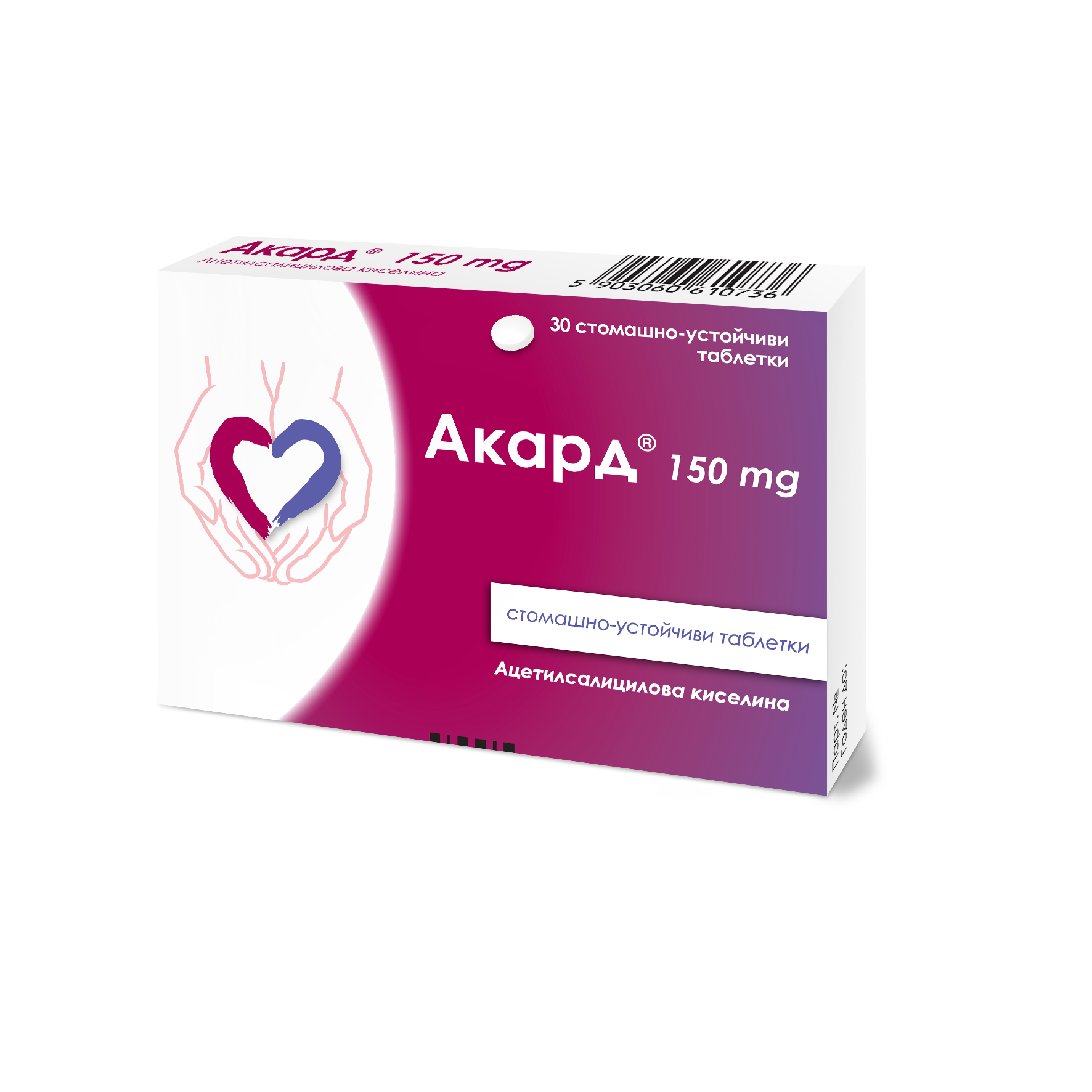
ACARD 150mg x 30 tabl
лекарствена информация Last retail price: 3.16 €
Add to Favourites
ACARD 150mg x 30 tabl
Patient information leaflet
AKARD 75 mg gastro-resistant tablets
AKARD 150 mg gastro-resistant tablets
Acetylsalicylic acid
ACARD 75 mg gastro-resistant tablets
ACARD 150 mg gastro-resistant tablets
Acetylsalicylic acid
Read all of this leaflet carefully before you start taking this medicine because it contains important information for you.
Always take this medicine exactly as described in this leaflet or as your doctor or pharmacist has told you.
- Keep this leaflet. You may need to read it again.
- If you need further information or advice, ask your pharmacist.
- If you get any side effects, tell your doctor or pharmacist. This includes any possible side effects not listed in this leaflet. See section 4.
- If you do not feel better or your condition worsens, you should seek medical attention.
What this leaflet contains
1. What Akard is and what it is used for
2. What you need to know before you take Akard
3. How to take Acard
4. Possible side effects
5. How to store Acard
6. Contents of the pack and other information
1. What Akard is and what it is used for
Acard contains acetylsalicylic acid, which in low doses belongs to a group of medicines called antiplatelet agents. Platelets are small cells in the blood that cause blood to clot and are involved in thrombosis. When a blood clot forms in an artery, it stops the blood flow and reduces the supply of oxygen. When this happens in the heart, it can cause a heart attack or angina; in the brain, it can cause a stroke.
Acard is used to reduce the risk of blood clots and thus prevent further:
- heart attacks
- strokes
- cardiovascular problems in patients who suffer from unstable angina (a type of chest pain).
Acard is also used to prevent blood clots after certain types of heart surgery, to widen or unblock blood vessels.
Acard is not recommended in emergency situations. It is limited to secondary prevention in chronic treatment.
2. What you need to know before you take Akard
Do not take Acard
- if you are allergic to acetylsalicylic acid, other salicylates or any of the other ingredients of this medicine (listed in section 6);
- if you have a bleeding diathesis or coagulation disorders: hemophilia (a blood clotting disorder that slows down the blood clotting process), thrombocytopenia (a condition in which you have a low number of platelets in your blood. This condition is sometimes associated with impaired bleeding);
- if you have or have ever had a stomach or small intestine ulcer or any other type of bleeding such as a stroke;
- if you have severe kidney damage;
- if you have severe liver damage;
- if you have severe heart failure;
- if you have asthma. History of aspirin-induced asthma attacks due to salicylates or medicinal products with similar effects, especially non-steroidal anti-inflammatory drugs (NSAIDs);
- if you are taking methotrexate (for example for cancer or rheumatoid arthritis) in doses of 15 mg/week or more;
- if you are in the third trimester of pregnancy;
- in children and adolescents under 16 years of age, due to the risk of Reye's syndrome (see below).
Warnings and precautions
Talk to your doctor or pharmacist before taking Acard:
- if you are in the first or second trimester of pregnancy;
- if you are breastfeeding;
- in case of hypersensitivity to non-steroidal anti-inflammatory and antirheumatic medicinal products or other allergenic substances;
- if you are taking anticoagulants (used to prevent blood clots);
- if you are taking ibuprofen, which may affect the antiplatelet effect of acetylsalicylic acid;
- if you have kidney or liver damage;
- if you have high blood pressure and/or heart failure
- if you have a history of peptic ulcer or gastrointestinal bleeding;
- if you are elderly;
- if you have gout;
- if you have heavy menstrual cycles;
- if you suffer from glucose-6-phosphate dehydrogenase deficiency.
Akard is not suitable for use as an anti-inflammatory/analgesic/antipyretic.
You should seek medical attention immediately if your symptoms worsen or if you experience serious or unexpected side effects, such as symptoms of unusual bleeding, serious skin reactions or other signs of a serious allergy (see section “Possible side effects”).
Acard should not be used for 5 days before elective surgery (including minor procedures such as tooth extraction).
Children and adolescents
During the course of some viral illnesses, especially in cases of influenza A, influenza B or varicella-zoster virus infections, mainly in children and adolescents, there is a risk of Reye's syndrome - a rare but life-threatening disease. Persistent vomiting during the course of the infection may be an indicator of Reye's syndrome, which requires immediate medical attention.
The risk of Reye's syndrome in the course of viral infections may increase with concomitant administration of acetylsalicylic acid, although a causal relationship has not been established.
For the above reasons, products containing acetylsalicylic acid should not be used in children and adolescents under 16 years of age.
Other medicines and Acard
Tell your doctor or pharmacist if you are taking, have recently taken or might take any other medicines.
Do not use Acard at the same time:
- if you are taking a medicine called methotrexate (for example for cancer or rheumatoid arthritis) at a dose higher than 15 mg per week or more.
Ask your doctor before taking any of the following medicines together with AKARD:
- methotrexate used in doses lower than 15 mg/week;
- coumarin derivatives, heparin (used to prevent blood clotting);
- selective serotonin reuptake inhibitors (SSRIs), such as sertraline or paroxetine (for depression);
- other non-steroidal anti-inflammatory drugs (NSAIDs), including salicylates and ibuprofen (to relieve pain and treat inflammation);
- benzpromarone and probenecid (for gout);
- digoxin (to treat heart problems);
- antidiabetic agents, such as insulin and sulfonylureas;
- thrombolytic medicinal products or other antithrombotic inhibitors (e.g. ticlopidine);
- diuretics (e.g. furosemide);
- corticosteroids (used for many conditions such as pain, swelling, allergy, asthma, rheumatism and skin problems);
- ACE inhibitors, e.g. enalapril, captopril (for the treatment of high blood pressure);
- valproic acid (for the treatment of epilepsy);
- acetazolamide (for the treatment of glaucoma);
- antacids (for indigestion) and adsorbents (e.g. kaolin for diarrhea);
- sulfonamide antibiotics;
- ciclosporin (used in organ transplantation to prevent rejection);
- metoclopramide (for nausea or vomiting);
- zafirlukast (for asthma).
Akard with food, drink and alcohol
Avoid drinking alcohol while taking Acard.
Pregnancy and breastfeeding
If you are pregnant or breast-feeding, think you may be pregnant or are planning to become pregnant, ask your doctor or pharmacist for advice before using this medicine.
Consult your doctor before using this medicine if you are in the first 6 months of pregnancy. Do not use it in the last 3 months of pregnancy.
Since acetylsalicylic acid is excreted in breast milk, Acard should not be taken by mothers who are breastfeeding due to the risk of Reye's syndrome in the child. High doses in the mother may impair platelet function in the child.
Driving and using machines
Acetylsalicylic acid does not affect the ability to drive or use machines.
3. How to take Acard
Always take this medicine exactly as described in this leaflet or as your doctor or pharmacist has told you. If you are not sure, ask your doctor or pharmacist.
You should seek advice from a doctor before starting treatment for the first time.
The recommended dose is 75 mg to 150 mg daily.
Old age
In general, acetylsalicylic acid should be used with caution in elderly patients, who are more susceptible to adverse reactions. Treatment should be reviewed at regular intervals.
Use in children and adolescents
Akard is contraindicated in children under 16 years of age (see section “Warnings and precautions”).
Kidney and liver damage
Acard should be used with caution in patients with impaired renal or hepatic function (avoid in severe impairment).
Method of administration
Oral use.
The tablets should be swallowed whole after meals with sufficient liquid (½ glass of water).
The enteric-coated tablet is coated and does not disintegrate in the stomach, thus reducing the irritating effect of acetylsalicylic acid on the gastric mucosa and therefore should not be crushed, broken or chewed.
If you take more Acard than you should
In case of overdose, contact your doctor, and in case of acute poisoning, the patient should be taken to hospital immediately.
Symptoms of overdose are usually: tinnitus, hyperventilation, fever, nausea, vomiting, blurred vision, headache, dizziness, confusion, acid-base and electrolyte imbalances, hypoglycemia, skin rashes.
In the event of acute overdose, delirium, tremors, shortness of breath, sweating, agitation, and coma may occur.
If you forget to take Acard
Do not take a double dose to make up for a forgotten tablet, just take the next dose at the usual time.
If you have any further questions on the use of this medicine, ask your doctor or pharmacist.
4. Possible side effects
Like all medicines, this medicine can cause side effects, although not everybody gets them.
Stop using this medicine and contact your doctor if you experience:
- first signs of an allergic reaction (for example, swelling of the face, lips, tongue, throat, causing difficulty breathing or swallowing);
- unusual bleeding, such as bloody sputum, blood in vomit or urine, or black stools.
The doctor will then assess the severity of the signs and decide how to proceed.
Other side effects of acetylsalicylic acid:
Common (may affect up to 1 in 10 people)
- indigestion (heartburn, nausea, vomiting) and abdominal pain.
Rare (may affect up to 1 in 1,000 people)
- gastrointestinal inflammation, gastric and/or duodenal ulcer, very rarely leading to gastrointestinal bleeding and perforation, characterized by clinical and laboratory signs;
- hypersensitivity reactions characterized by laboratory and clinical signs, including: angioedema, skin reactions, edema; severe hypersensitivity reactions, including anaphylactic shock;
- severe bleeding, e.g. gastrointestinal bleeding and intracranial bleeding (especially in patients with uncontrolled high blood pressure and/or during concomitant administration of antihaemostatics), which in individual cases can be potentially life-threatening;
- transient liver dysfunction with elevated transaminases (a group of enzymes that show how the liver is working);
- hypersensitivity reactions characterized by laboratory and clinical signs, including: asthma, difficulty breathing or wheezing;
- unusually heavy or prolonged menstrual cycles.
Very rare (may affect up to 1 in 10,000 people)
- low blood sugar;
- bullous reactions, including Stevens-Johnson syndrome and toxic epidermal necrolysis;
- impaired kidney function, urate kidney stones.
Not known (frequency cannot be estimated from the available data)
- increased risk of bleeding, prolongation of bleeding time, thrombocytopenia - reduction in platelet count;
- perioperative hemorrhage, hematomas, nosebleeds, urogenital bleeding, bleeding gums;
- dizziness and ringing in the ears (tinnitus), which are usually symptoms of overdose;
- liver failure, Reye's syndrome;
- hypersensitivity reactions characterized by laboratory and clinical signs, including: serious allergic reaction that causes swelling of the face or throat, skin reactions, fluid retention (edema), rash, hives, itching, heart and respiratory disorders.
Reporting side effects
If you get any side effects, please tell your doctor or pharmacist. This includes any possible side effects not listed in this leaflet. You can also report side effects directly via
Executive Agency for Medicines
8 Damyan Gruev Street
1303, Sofia
Tel.: +35 928903417
website: www.bda.bg
By reporting side effects, you can help provide more information about the safety of this medicine.
5. How to store Acard
Keep out of the reach of children.
Do not store above 25°C. Store in the original package in order to protect from moisture.
Do not use this medicine after the expiry date which is stated on the blister and carton. The expiry date refers to the last day of that month.
Do not throw away any medicines via wastewater or household waste. Ask your pharmacist how to dispose of medicines you no longer use. This will help to protect the environment.
6. Contents of the pack and other information
What Akard contains
- The active substance is acetylsalicylic acid.
Each Acard 75 mg gastro-resistant tablet contains 75 mg of acetylsalicylic acid.
Each Acard 150 mg gastro-resistant tablet contains 150 mg of acetylsalicylic acid.
- The other ingredients are:
- powdered cellulose, corn starch, sodium starch glycolate (type C) - in the tablet core;
- hypromellose, triethyl citrate, simethicone emulsion, methacrylic acid and ethyl acrylate copolymer (1:1), talc, titanium dioxide, colloidal anhydrous silica, sodium hydrogen carbonate, sodium lauryl sulfate - in the tablet coating.
What Akard looks like and contents of the pack
Acard 75 mg is a white, heart-shaped, biconvex film-coated tablet.
Akard 150 mg is a white, round and biconvex film-coated tablet.
The product is available in blisters of 30 or 60 gastro-resistant tablets.
Not all types of packaging can be released for sale.
Marketing Authorisation Holder and Manufacturer
Marketing Authorisation Holder
Pharmaceutical Works POLPHARMA SA
19, Pelplińska Street
83-200 Starogard Gdański, Poland
Manufacturer
Pharmaceutical Works POLPHARMA SA
19, Pelplińska Street
83-200 Starogard Gdański, Poland
Pharmaceutical Works POLPHARMA SA
Production Department in Nowa Dęba
1, Szypowskiego Street
39-460 Nowa Deba, Poland
This medicinal product is authorised in the Member States of the EEA under the following names:
Bulgaria: AKARD 75 mg gastro-resistant tablets
AKARD 150 mg gastro-resistant tablets
Latvia: BETACARDO 75 mg zarnās shĂstošās tablets
BETACARDO 150 mg soluble tablets
Lithuania: BETACARDO 75 mg skrandyje neirios tabletės
BETACARDO 150 mg skrandyje neirios tabletės
Date the leaflet was last revised
Express Delivery (within 2 hours)
- Valid only for the city of Sofia
- Valid only for orders over €25.56 | 50.00 BGN
- Valid only for cash on delivery (cash or card payment upon receipt)
Delivery to a Pharmacy
- Completed within up to 2 business days
- Valid for Sofia, Bozhurishte, and Mramor
- Free delivery
- Valid only for online payment
Courier Delivery to an Address
- Completed within up to 3 business days
- €2.30 | 4.50 BGN for orders under €25.56 | 50.00 BGN
- Free for orders over €25.56 | 50.00 BGN
Delivery to a Speedy Office
- Completed within up to 3 business days
- €2.30 | 4.50 BGN for orders under €25.56 | 50.00 BGN
- Free for orders over €25.56 | 50.00 BGN
BOX NOW
- Completed within up to 3 business days
- €1.53 | 2.99 BGN for orders under €25.56 | 50.00 BGN
- Free delivery for orders over €25.56 | 50.00 BGN
* Delivery times may change during large-scale campaigns and busy periods (Black Friday, public holidays, etc.).
* When ordering to a Speedy office, the customer has 5 business days from the delivery date to collect their order. After this period, the order is canceled and returned to the warehouse at subra.bg.

Express delivery for Sofia city Learn more

Free shippingover 50.00 lv / 25.56 €

Click and collect Learn more

Check the shipment Learn more
Book and collect from pharmacy
Availability in store
ACARD 150mg x 30 tabl
Please add your email, to receive notification when the product is in stock