


 Click & collect
Ще се изтрие най-старият артикул от любими и ще се добави новият

Coming soon
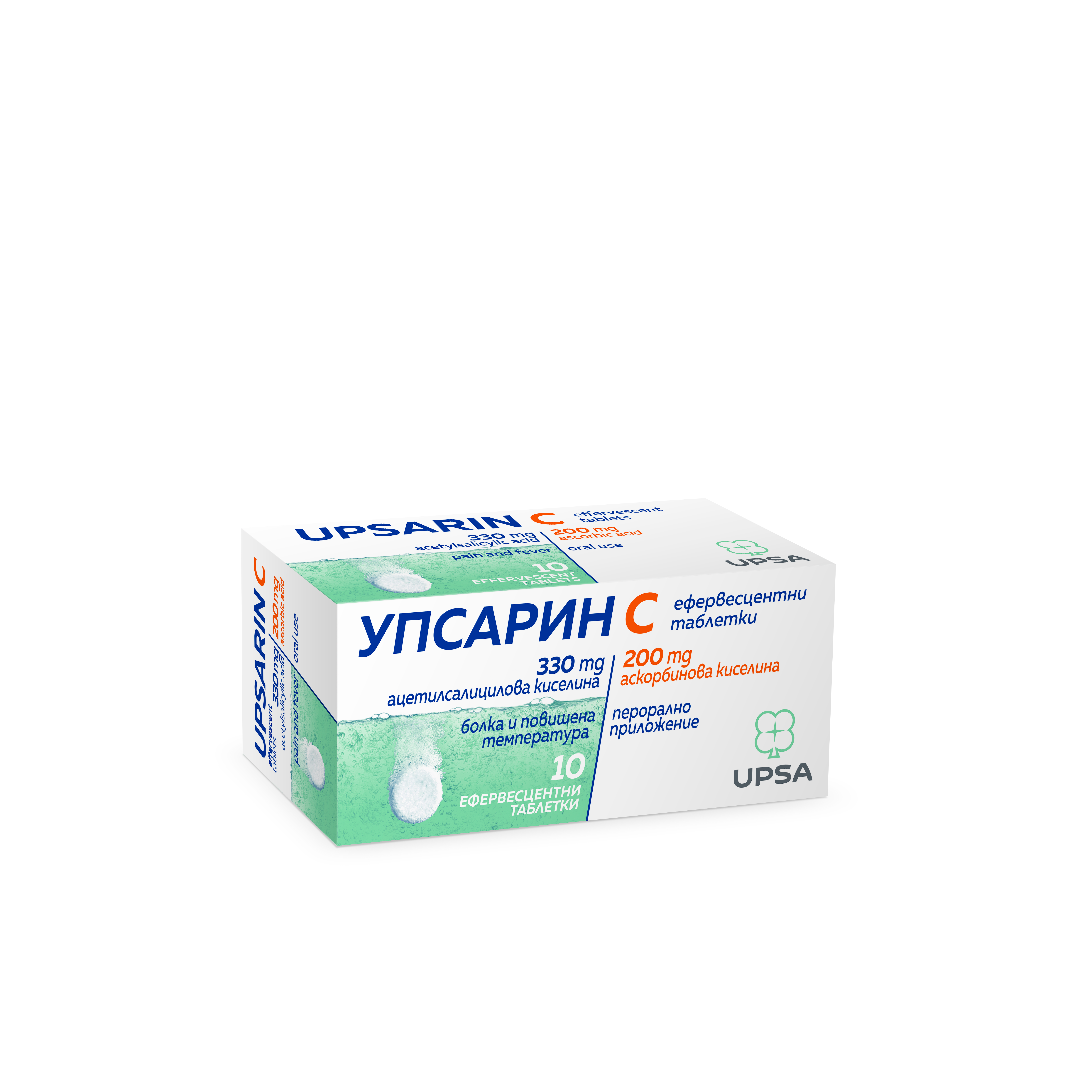
UPSARIN + VITAMIN-C x 10 eff tabl
лекарствена информация Last retail price: 2.45 €
Add to Favourites
UPSARIN + VITAMIN-C x 10 eff tabl
Leaflet: information for the user
UPSARIN C 330 mg/200 mg effervescent tablets
Acetylsalicylic acid/Ascorbic acid
UPSARIN C 330 mg/200 mg effervescent tablets
Acetylsalicylic acid/Ascorbic acid
Read all of this leaflet carefully before you start taking this medicine because it contains important information for you.
Always take this medicine exactly as described in this leaflet or as your doctor, pharmacist or nurse has told you.
- Keep this leaflet. You may need to read it again.
- If you need further information or advice, ask your pharmacist.
- If you get any side effects, tell your doctor, pharmacist or nurse. This includes any possible side effects not listed in this leaflet. See section 4.
- If after 3 days in case of high fever or 5 days in case of pain, you do not feel better or your condition worsens, you should seek medical attention.
What this leaflet contains
1. What UPSARIN C is and what it is used for
2. What you need to know before you take UPSARIN S
3. How to take UPSARIN S
4. Possible side effects
5. How to store UPSARIN S
6. Contents of the pack and other information
1. What UPSARIN C is and what it is used for
This medicine contains acetylsalicylic acid and vitamin C.
This medicinal product is an analgesic (relieves pain) and an antipyretic (reduces fever).
It is recommended for the symptomatic relief of illnesses accompanied by pain and/or high body temperature, such as headache, flu-like conditions, toothache, body aches, in adults and children weighing over 30 kg (around and over 12 years). If after 3 days, in the case of high fever, or 5 days, in the case of pain, you do not feel better or your condition worsens, you should seek medical attention.
2. What you need to know before you take UPSARIN S
Do not take UPSARIN with:
- if you are allergic to the active substances or any of the other ingredients of this medicine (listed in section 6);
- if you are pregnant from the beginning of the 6th month (more than 24 weeks of amenorrhea);
- if you have a history of asthma triggered by taking aspirin or a related medicine (especially non-steroidal anti-inflammatory drugs). in case of active stomach or duodenal ulcer;
- if you have a hemorrhagic disease or risk of bleeding;
- if you have severe liver disease;
- if you have severe kidney disease;
- if you have severe heart disease;
- in case of kidney stones, due to taking vitamin C in doses above 1 g daily;
- if you are being treated with methotrexate in doses exceeding 20 mg per week, and when acetylsalicylic acid is used in high doses as an anti-inflammatory agent (≥ 1 g per dose and/or ≥ 3 g per day), especially in the treatment of rheumatic diseases, or in the treatment of elevated temperature or pain (≥ 500 mg per dose and/or < 3 g per day) (see Other medicines and UPSARIN C);
- if you are being treated with oral anticoagulants, and in cases of a history of gastric and duodenal ulcers, and when acetylsalicylic acid is prescribed in high doses as an anti-inflammatory agent (≥ 1 g per dose and/or ≥ 3 g daily), especially in the treatment of rheumatic diseases, or in the treatment of fever or pain (≥ 500 mg per dose and/or 3 g daily) (see Other medicines and UPSARIN C).
Warnings and precautions
Talk to your doctor, pharmacist or nurse before taking UPSARIN S.
- To avoid the risk of overdose, when combining with other medicinal products, make sure that the other medicinal products do not contain acetylsalicylic acid.
- In case of headache after prolonged use of acetylsalicylic acid in high doses, do not increase the dose, but consult your doctor or pharmacist. Regular use of analgesics, especially a combination of several analgesics, can lead to kidney damage.
- “Reye's syndrome” (a rare but very serious illness associated primarily with neurological disorders and liver damage) has been observed in children with viral illnesses who have been treated with acetylsalicylic acid.
Therefore:
- in case of a viral illness, such as chickenpox or a flu-like episode: do not give acetylsalicylic acid to a child without consulting a doctor;
- in case of impaired consciousness or unusual behavior and vomiting in children taking acetylsalicylic acid, inform a doctor immediately.
Acetylsalicylic acid should only be taken after consulting your doctor:
- in the case of treatment of rheumatic diseases;
- in case of glucose-6-phosphate dehydrogenase deficiency (an inherited disease affecting red blood cells), as high doses of acetylsalicylic acid may cause hemolysis (destruction of red blood cells);
- in case of a history of stomach and duodenal ulcers, gastrointestinal bleeding or gastritis;
- in case of kidney or liver disease;
- in patients with asthma: in some patients, the occurrence of an asthma attack may be associated with an allergy to non-steroidal anti-inflammatory drugs or to acetylsalicylic acid. In these cases, the drug should not be taken; in case of excessive menstrual bleeding;
- in case of treatment with:
- oral anticoagulants when high doses of acetylsalicylic acid are used to treat fever or pain (≥ 500 mg per dose and/or < 3 g daily) without a history of gastric or duodenal ulcer;
- oral anticoagulants, when low doses of acetylsalicylic acid are used as an antiplatelet agent (from 50 mg to 375 mg daily) with a history of gastric or duodenal ulcer;
- non-steroidal anti-inflammatory medicinal products, when high doses of acetylsalicylic acid are used as an anti-inflammatory agent (≥ 1 g per dose and/or ≥ 3 g per day), especially in the treatment of rheumatic diseases, high fever or pain (≥ 500 mg per dose and/or < 3 g per day);
- glucocorticoids (except hydrocortisone as replacement therapy) when high doses of acetylsalicylic acid are used as an anti-inflammatory agent (≥ 1 g per dose and/or ≥ 3 g daily), especially in the treatment of rheumatic diseases;
- heparins used in therapeutic doses and/or in patients over 65 years of age, when high doses of acetylsalicylic acid are used as an anti-inflammatory agent (≥ 1 g per dose and/or ≥ 3 g per day), especially in the treatment of rheumatic diseases, high fever or pain (≥ 500 mg per dose and/or < 3 g per day);
- medicinal products used in the treatment of gout;
- acetazolamide;
- anagrelide;
- clopidogrel;
- ticagrelor;
- pemetrexed in patients with mild to moderate renal function;
- ticlopidine tenofovir disoproxil (fumarate)
- uricosurics (see Other medicinal products and UPSARIN C).
During treatment: in case of gastrointestinal bleeding (oral bleeding, blood in the stool, black stools), STOP THERAPY IMMEDIATELY AND CONTACT A DOCTOR OR EMERGENCY MEDICAL CARE.
This medicine contains acetylsalicylic acid and vitamin C. Other medicines also contain them.
Make sure that you or your child are not taking any other medicines containing acetylsalicylic acid and/or non-steroidal anti-inflammatory drugs and/or vitamin C, including medicines obtained without a prescription.
Do not combine them to avoid exceeding the recommended daily dose.
(see “Dosage” and “If you take more UPSARIN C than you should”).
Pain or fever:
This product is suitable for adults and children weighing over 30 kg (from about 12 years).
If you have any further questions, please contact your doctor or pharmacist for advice.
If the pain persists for more than 5 days or the fever persists for more than 3 days, or if there is no improvement or other symptoms appear, do not continue treatment without consulting your doctor.
Acetylsalicylic acid increases the risk of bleeding even in very low doses, even when taken a few days earlier. INFORM YOUR DOCTOR, SURGEON, ANESTHESIOLOGY OR DENTIST if you are scheduled for even a minor surgical procedure.
Acetylsalicylic acid changes uricemia (the amount of uric acid in the blood).
Vitamin C should be used with caution in patients suffering from iron metabolism disorders, a predisposition to urinary tract formations or kidney stones (presence of crystals in the urine or kidneys), and in patients with glucose-6-phosphate dehydrogenase deficiency.
Due to the slightly stimulating effect of vitamin C, it is not recommended to take this medicinal product at the end of the day.
CONSULT YOUR DOCTOR OR PHARMACIST IF YOU ARE NOT SURE ABOUT ANYTHING.
Other medicines and UPSARIN C
You should tell your doctor or pharmacist if you are taking, have recently taken or might take any other medicines.
When taking high doses of acetylsalicylic acid as an anti-inflammatory agent (≥ 1 g per dose and/or ≥ 3 g per day), especially in the treatment of rheumatic diseases, high body temperature or pain (≥ 500 mg per dose and/or < 3 g per day), this medicinal product should not be used in combination with:
- methotrexate used in doses higher than 20 mg per week;
- oral anticoagulants and in cases of gastric or duodenal ulcer.
The combination of this medicinal product with:
- oral anticoagulants when high doses of acetylsalicylic acid are used to treat fever or pain (≥ 500 mg per dose and/or < 3 g daily) and if there is no history of gastric or duodenal ulcer;
- oral anticoagulants, when low doses of acetylsalicylic acid are used as an antiplatelet agent (from 50 mg to 375 mg daily) and in patients with a history of gastric and duodenal ulcers;
- non-steroidal anti-inflammatory drugs, when high doses of acetylsalicylic acid are used as an anti-inflammatory agent (≥ 1 g per dose and/or ≥ 3 g per day), especially in the treatment of rheumatic diseases or high fever or pain (≥ 500 mg per dose and/or ≥ 3 g per day);
- glucocorticoids (except hydrocortisone in replacement therapy) when high doses of acetylsalicylic acid are used as an anti-inflammatory agent (≥ 1 g per dose and/or ≥ 3 g daily), especially in the treatment of rheumatic diseases;
- heparins used in therapeutic doses and/or in patients over 65 years of age, when high doses of acetylsalicylic acid are used as an anti-inflammatory agent (≥ 1 g per dose and/or ≥ 3 g per day), especially in the treatment of rheumatic diseases, high body temperature or pain (≥ 500 mg per dose and/or < 3 g per day);
- medicinal products used in the treatment of gout;
- acetazolamide;
- anagrelide;
- clopidogrel;
- pemetrexed in patients with mild to moderate renal function;
- ticagrelor;
- ticlopidine;
- uricosurics (see "Warnings and precautions").
At doses above 2 g daily of vitamin C, ascorbic acid may interfere with the following laboratory tests: creatinine tests and blood and urine glucose tests (glucose oxidase test - a strip for diabetes control).
Tell your doctor or pharmacist if you are taking deferoxamine to eliminate excess iron and aluminum in the blood.
In order to avoid possible interactions between several medicines, always inform your doctor or pharmacist if you are taking other medicines.
UPSARIN C with food, drinks and alcohol
Not applicable.
Pregnancy, breastfeeding and fertility
If you are pregnant or breast-feeding, think you may be pregnant or are planning to become pregnant, ask your doctor or pharmacist for advice before using this medicine.
Pregnancy
This medicine contains acetylsalicylic acid. Do not take other medicines containing acetylsalicylic acid (including medicines obtained without a prescription).
For doses between 100 mg and 500 mg daily:
As a precaution, the recommendations below apply unless otherwise prescribed by your medical professional.
For doses higher than 500 mg daily:
- Before the beginning of the 6th month of pregnancy (up to 24 weeks of amenorrhea),
You should not take this medicine unless your doctor considers it absolutely necessary, as there is a risk of miscarriage or malformations. In this case, the dose should be as low as possible and the duration of treatment as short as possible.
- From the beginning of the 6th month of pregnancy (24 weeks of amenorrhea), this medicine is contraindicated and should not be taken UNDER ANY CIRCUMSTANCES, as its effects on your child may have serious or even fatal consequences, especially on the heart, lungs and/or kidneys, even from a single dose.
If you have taken this medicinal product during pregnancy, you should consult your gynecologist so that you can receive appropriate follow-up if necessary.
Breastfeeding
It is not recommended to take acetylsalicylic acid during breastfeeding, as it passes into breast milk.
CONSULT YOUR DOCTOR OR PHARMACIST BEFORE TAKING ANY MEDICINE.
Fertility
Acetylsalicylic acid, like all non-steroidal anti-inflammatory drugs (NSAIDs), may impair fertility in women and may cause difficulty in conceiving, which is reversible upon discontinuation of treatment. Tell your doctor if you are planning to become pregnant or have difficulty conceiving.
Driving and using machines
Upsarin C does not affect the ability to drive and use machines.
UPSARIN C contains sodium and sodium benzoate (E211).
This medicine contains 485 mg sodium (main ingredient of cooking/table salt) in each effervescent tablet. This amount is equivalent to 24.3% of the recommended maximum daily dietary intake of sodium for an adult. Talk to your doctor or pharmacist if you need one or more effervescent tablets per day for a long period of time, especially if you have been advised to follow a low-salt (sodium) diet.
This medicine contains 48 mg of sodium benzoate (E211) in each effervescent tablet.
3. How to take UPSARIN S
Always take this medicine exactly as described in this leaflet or as your doctor, pharmacist or nurse has told you. If you are not sure, ask your doctor or pharmacist.
Dosage
This medicinal product is intended for adults and children weighing over 30 kg (i.e. around 12 years).
For pain, high fever:
For adults and children weighing more than 50 kg (over 15 years), the recommended maximum daily dose is 3 g of acetylsalicylic acid, i.e. 9 effervescent tablets per day.
The usual dose is two 330 mg tablets, and if necessary, the dose is repeated at intervals of at least 4 hours, without exceeding 9 effervescent tablets per day.
Elderly patients: the recommended maximum daily dose is 2 g.
The usual dose is 1 tablet of 330 mg, if necessary, the dose is repeated after at least 4 hours. In case of more intense pain or fever, 2 tablets of 330 mg, if necessary, the dose is repeated after at least 4 hours, without exceeding 6 effervescent tablets per day.
Use in children: the recommended maximum daily dose in children is 50 mg/kg.
The dose is determined by body weight. The approximate age in relation to weight is given as a guide only.
If you do not know your child's weight, you should weigh them to administer the most appropriate dose.
The usual dose for children weighing between 30 and 50 kg (12 to 15 years of age): 1 tablet (330 mg), and if necessary, the dose is repeated after 4 hours, without exceeding 6 effervescent tablets per day.
IF YOU ARE NOT SURE ABOUT SOMETHING, CONSULT YOUR DOCTOR OR PHARMACIST.
Method and route of administration
Oral administration.
Drink immediately after the tablet has completely dissolved in a large glass of water.
In addition, if your child has a temperature above 38.5°C, you can improve the efficacy of treatment by taking the following measures:
• undress the child,
• hydrate it,
• do not leave your child in a place where it is too hot.
Frequency of application
For pain, high fever: regular use helps avoid fluctuations in pain or temperature levels.
In adults: there should be an interval of at least 4 hours between doses.
In children: there should be a regular interval between doses, including at night, preferably an interval of 6 hours and at least 4 hours (the dosages specified above must be observed).
Since the medicine contains ascorbic acid, its administration at the end of the day should be avoided.
Duration of treatment
The duration of treatment is limited:
- up to 5 days in case of pain;
- up to 3 days in case of high fever.
If the pain lasts more than 5 days or the fever lasts more than 3 days, or if your condition worsens, do not continue treatment without the advice of a doctor or pharmacist.
If you take more UPSARIN C than you should
Acetylsalicylic acid overdose
During treatment, it is possible to experience:
Tinnitus, sensation of reduced hearing, headache and dizziness: these are the common symptoms of an overdose of acetylsalicylic acid.
If any of these occur, STOP TREATMENT AND INFORM YOUR DOCTOR.
In case of accidental poisoning (especially common in young children), CONSULT A DOCTOR IMMEDIATELY.
Vitamin C overdose
- At doses higher than 2 g per day, vitamin C may interact with the following laboratory tests: creatinine and glucose tests in blood and urine (glucose oxidase test - a strip for diabetes control).
- At doses higher than 3 g daily of vitamin C, there is a risk of hemolysis (destruction of red blood cells) in patients with glucose-6-phosphate dehydrogenase deficiency (an enzyme specific to red blood cells).
If you forget to take UPSARIN S
Do not take or give your child a double dose to make up for a missed dose.
If you have any further questions on the use of this medicine, ask your doctor, pharmacist or nurse.
4. Possible side effects
Like all medicines, this medicine can cause side effects, although not everybody gets them.
Medicines such as UPSARIN C may increase the risk of bleeding, hypertension, edema, heart failure, cerebral hemorrhage and intracranial hemorrhage.
Related to acetylsalicylic acid
You should stop treatment immediately and inform your doctor in the following cases:
- gastrointestinal bleeding, gastrointestinal perforation or peptic ulcer (abdominal pain, upper abdominal pain, vomiting blood [“haematemesis”] or blood in the stools, black stools [“melaena”], gastritis, exacerbation of inflammation of the intestines [“colitis”] or Crohn's disease (see “Warnings and precautions”). These side effects occur more often when taking high doses;
- allergic reactions such as skin rashes, asthma attacks, Quincke's edema (urticaria of the face with impaired breathing);
- tinnitus, sensation of reduced hearing, headache, dizziness: these are the usual symptoms of an overdose of acetylsalicylic acid;
- Reye's syndrome (occurrence of impaired consciousness, unusual behavior and vomiting), in children with symptoms of viral diseases and taking acetylsalicylic acid (see "Warnings and precautions");
- very rarely, bullous manifestations of the skin or mucous membrane may occur (burning sensation accompanied by redness with blisters, blistering and ulceration).
Tell your doctor if you experience abdominal pain or bleeding from the nose or gums.
Cases of digestive disorders, such as stomach pain, vomiting, nausea, diarrhea, constipation, bloating, indigestion have been reported.
Related to vitamin C
High doses of vitamin C (over 1 g daily) can cause:
- digestive disorders (heartburn, diarrhea, abdominal pain);
- urinary tract disorders (discomfort when urinating or unusual discoloration of urine).
At doses above 3 g daily of vitamin C, there is a risk of hemolysis in individuals with G6PD deficiency (lack of a red blood cell enzyme).
Cases of dizziness, urticaria and rashes have been reported.
Reporting side effects
If you get any side effects, please tell your doctor or pharmacist. This includes any possible side effects not listed in this leaflet. You can also report side effects directly via:
Executive Agency for Medicines
8 Damyan Gruev Street
1303 Sofia
tel.: +359 2 8903417
website: www.bda.bg
By reporting side effects, you can help provide more information about the safety of this medicine.
5. How to store UPSARIN S
Keep out of the reach of children.
Do not use this medicine after the expiry date which is stated on the carton. The expiry date refers to the last day of that month.
Store below 25°C.
Store in a tightly closed tablet container in order to protect from moisture.
Do not throw away any medicines via wastewater or household waste. Ask your pharmacist how to dispose of medicines you no longer use. This will help to protect the environment.
6. Contents of the pack and other information
What UPSARIN S contains
Active ingredients:
- Acetylsalicylic acid (Acetylsalicylic acid) 330 mg;
- Ascorbic acid (Ascorbic acid) 200 mg;
Other ingredients: anhydrous citric acid, sodium bicarbonate, sodium benzoate (E211), povidone.
What UPSARIN C looks like and what the pack contains
Effervescent tablet with a score line.
Box with two tablet packs of 10 effervescent tablets each.
Box with one tablet pack of 10 effervescent tablets.
Marketing Authorisation Holder and Manufacturer
Marketing Authorisation Holder
UPSA SAS
3, Rue Joseph Monier,
92500 Rueil-Malmaison,
France
Manufacturer
UPSA SAS
979 Avenue des Pyrenees
47520 Le Passage, France
or
UPSA SAS
304, avenue du Docteur Jean Bru
47000 Agen, France
Date of last revision of the leaflet 06/2024
Express Delivery (within 2 hours)
- Valid only for the city of Sofia
- Valid only for orders over €25.56 | 50.00 BGN
- Valid only for cash on delivery (cash or card payment upon receipt)
Delivery to a Pharmacy
- Completed within up to 2 business days
- Valid for Sofia, Bozhurishte, and Mramor
- Free delivery
- Valid only for online payment
Courier Delivery to an Address
- Completed within up to 3 business days
- €2.30 | 4.50 BGN for orders under €25.56 | 50.00 BGN
- Free for orders over €25.56 | 50.00 BGN
Delivery to a Speedy Office
- Completed within up to 3 business days
- €2.30 | 4.50 BGN for orders under €25.56 | 50.00 BGN
- Free for orders over €25.56 | 50.00 BGN
BOX NOW
- Completed within up to 3 business days
- €1.53 | 2.99 BGN for orders under €25.56 | 50.00 BGN
- Free delivery for orders over €25.56 | 50.00 BGN
* Delivery times may change during large-scale campaigns and busy periods (Black Friday, public holidays, etc.).
* When ordering to a Speedy office, the customer has 5 business days from the delivery date to collect their order. After this period, the order is canceled and returned to the warehouse at subra.bg.

Express delivery for Sofia city Learn more

Free shippingover 50.00 lv / 25.56 €

Click and collect Learn more

Check the shipment Learn more
Book and collect from pharmacy
Availability in store
UPSARIN + VITAMIN-C x 10 eff tabl
Please add your email, to receive notification when the product is in stock