


 Click & collect

Ще се изтрие най-старият артикул от любими и ще се добави новият
In stock
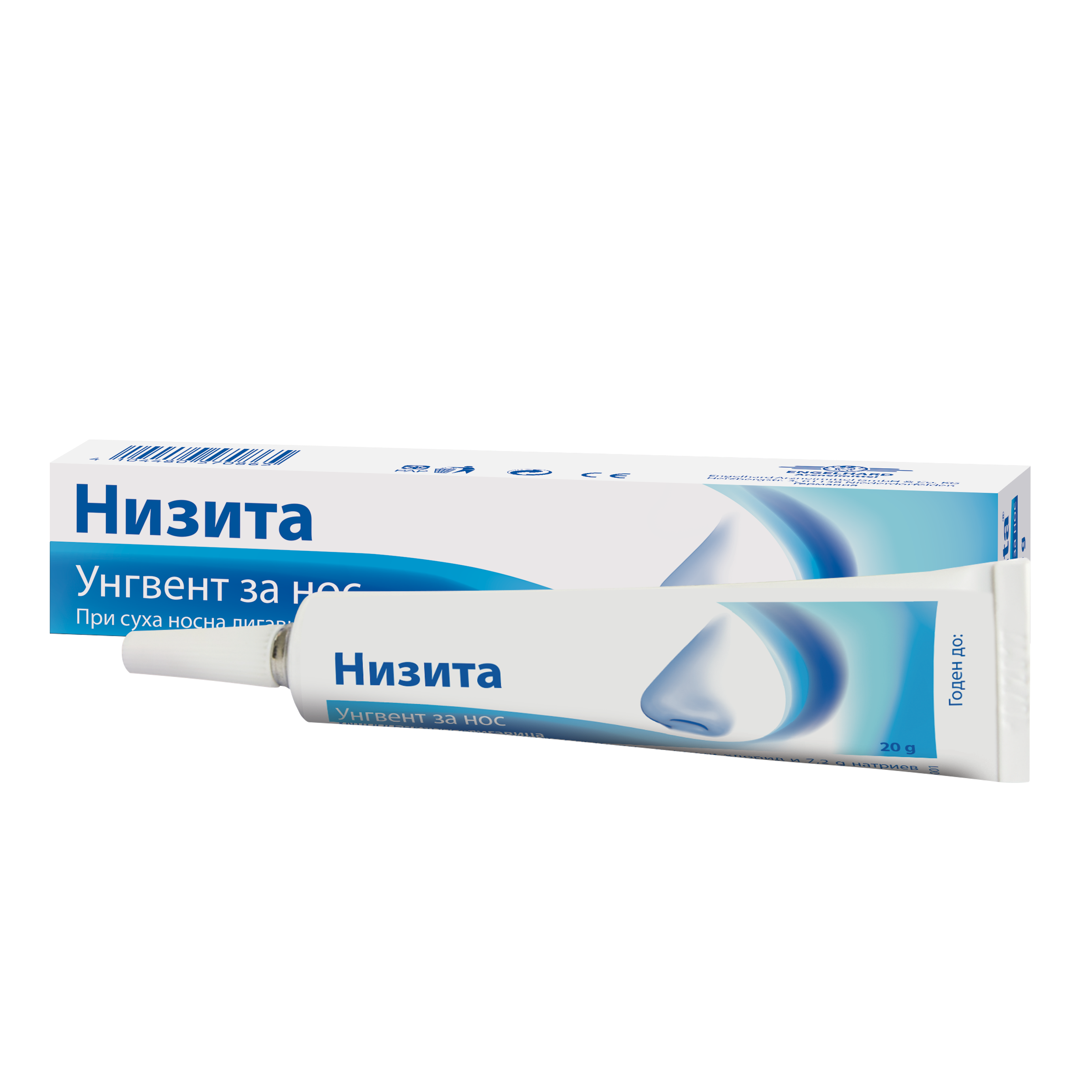
NISITA ung.20g
7.05 €
Add to Favourites
NISITA ung.20g
Nisita / Nisita ointment is a medical device in the form of an ointment, intended for use in the treatment of dry nasal mucosa.
It helps unclog the nose, for example with a cold, and helps clean and moisturize the nasal mucosa - especially in dry air.
Softens scabs and crusts.
Contains sodium chloride and sodium hydrogen carbonate. Contains no preservatives!
It is suitable for infants, children, adults, pregnant and breastfeeding women.
Application and dosage of Nizita nasal ointment:
About 1 cm of the ointment is introduced into each nostril, several times a day and before bedtime.
Insert the tip of the tube as deep as possible into the nostril, squeeze out a little of the solution and distribute it evenly over the nasal mucosa, gently massaging on both sides of the nose.
For hygiene reasons and to prevent infections, each tube of Nizita nasal spray should only be used by one person. The tip should be cleaned after use.
No restriction on use after opening within the product's shelf life.
Leaflet: information for the user
Nizita Nasal Ointment
Dear patients,
Please read this leaflet carefully because it contains important information that you should take into account when using this product. If you have any questions, ask your doctor or pharmacist.
What does Nizita nasal ointment contain?
100 g of ointment contain 2.8 g of sodium chloride and 7.2 g of sodium hydrogen carbonate.
Other ingredients: lanolin alcohol, lemon oil, white petrolatum, medium chain triglycerides, liquid paraffin, cetylstearyl alcohol.
When is Nizita nasal ointment used?
Nisita nasal ointment is used in cases of dry nasal mucosa.
helps unclog the nose, for example with a cold
cleans and moisturizes the nasal mucosa, for example in dry air conditions
softens scabs and crusts
Nisita nasal ointment is suitable for adults, children and infants.
When should you not use Nizita nasal ointment?
Nisita nasal ointment should not be used in case of hypersensitivity to any of the ingredients of the product.
What precautions are necessary when using Nizita nasal ointment?
When used correctly, no special precautions are necessary.
However, after nasal surgery or accidents, consultation with a doctor is necessary before using Nizita nasal ointment.
Can Nizita ointment be used during pregnancy and breastfeeding?
There is no evidence of harmful effects of Nizita nasal ointment during pregnancy and breastfeeding.
How to use Nizita nasal ointment?
About 1 cm of the ointment is introduced into each nostril, several times a day.
Place the tip of the tube as deep as possible into the nostril, squeeze out a little of the ointment and distribute it evenly over the nasal mucosa by gently massaging on both sides of the nose.
The ointment can also be placed in the nose using a cotton swab.
The ointment should be applied several times daily and before bedtime.
For reasons of hygiene and to prevent infection, each tube of Nizita Nasal Ointment should be used by one person only. The tip should be cleaned after use.
How long can you use Nizita nasal ointment?
Nizita nasal ointment can be used for a long period of time if necessary. If symptoms do not improve after 14 days of therapy, please consult your doctor or pharmacist.
What side effects can Nizita nasal ointment cause?
In rare cases, Nizita nasal ointment may cause a slight burning sensation on the nasal mucosa.
Very rarely, lanolin alcohol and lemon oil contained in the ointment may cause hypersensitivity reactions.
What else should be considered?
Nisita nasal ointment can only be used until the date marked on the carton and tube.
Note:
Always store Nizita Nasal Ointment in the outer packaging during daily use to protect the tube from damage. Nizita Nasal Ointment contains a mixture of liquid and solid fats, which may change slightly if stored incorrectly (below 15°C or above 25°C). At higher temperatures, the ointment may separate. As a result, some fat may leak out when first opened. When stored at lower temperatures, it may be difficult to squeeze the ointment out of the tube. To avoid damaging the tube, for example by bending it, the ointment should always be squeezed from the back to the front.
The small amount of air in the tube obtained during filling does not affect either the efficacy or the amount of product.
Packaging details
Package of 20 g of ointment.
Last edited date:
January 2012
Marketing Authorisation Holder and Manufacturer:
Engelhard Arzneimittel GmbH & Co. KG
Herzbergstrasse 3, 61138 Niederdorfelden, Germany
Distributor:
Salveo Bulgaria EOOD
Sofia, 1505, 48 Sitnyakovo Blvd., 8th floor
www.salveopharma.bg
Keep out of reach of children!
Information about Nizita nasal spray
The mucous membrane of the respiratory tract
The respiratory tract is covered with a mucous membrane that ensures the proper functioning of the respiratory organs. The mucous membrane of the upper respiratory tract contains secretory cells and ciliated cells (the so-called cilia). The secretory cells produce a liquid (secretion) that moistens the inhaled air (about 10,000 liters per day) while at the same time retaining dust, dirt, pathogens, etc. With the help of the cilia, which are in constant motion, foreign bodies are transported outside or through the throat to the stomach.
When the mucous membrane is dry, it cannot perform its natural function. This makes it easier for pathogens to enter, impairs the sense of smell and taste, and can also lead to irritation of the nasal mucosa.
Our nose – functions and tasks
The nose performs various functions aimed at protecting the respiratory tract from diseases. The inhaled air is brought almost to body temperature through the nose, i.e. in winter, cold air is warmed up, and in summer, very hot air is cooled down. Additionally, the inhaled air is humidified and filtered in the nose so that inhaled dust particles are removed and only clean air reaches the lungs. For this reason, breathing should be done through the nose, not through the mouth. However, this is not possible when the function of the nose is impaired and the nasal mucosa is too dry.
Dry nose
This is a common problem that affects all age groups and can occur in any season. The scabs that form are not only annoying, they can sometimes be painful. Susceptibility to infections increases, breathing, smell and taste become difficult. This leads to a deterioration in the quality of life.
Dry nasal mucosa can be caused by:
- side effects from taking certain medications
- certain diseases, e.g. diabetes or rheumatism, often also lead to drying of the nasal mucosa
- heated and air-conditioned rooms
- dust or other irritants
- sometimes dry nasal mucosa is age-related
Recommendations and treatment options
The healing effects of salts (sodium chloride) have been used by people for hundreds of years.
Staying in salty sea air and inhaling salt spring water relieves respiratory complaints.
The salts contained in the ointment, due to their ability to retain water, maintain a moist environment in the nose.
Nisita nasal ointment is widely applicable
For prevention
- protects the nasal mucosa from drying out
- limits the contact of irritating substances with the nasal mucosa
For treatment
- moisturizes the nasal mucosa
- washes away scabs
- helps treat runny nose in infants and children
- improves nasal breathing and thus can lead to a reduction in snoring
For aftercare
- supports the regeneration of damaged nasal mucosa in case of runny nose, nosebleeds and after surgeries.
In case of dry nasal mucosa, you can also use Nizita nasal spray.
Express Delivery (within 2 hours)
- Valid only for the city of Sofia
- Valid only for orders over €25.56 | 50.00 BGN
- Valid only for cash on delivery (cash or card payment upon receipt)
Delivery to a Pharmacy
- Completed within up to 2 business days
- Valid for Sofia, Bozhurishte, and Mramor
- Free delivery
- Valid only for online payment
Courier Delivery to an Address
- Completed within up to 3 business days
- €2.30 | 4.50 BGN for orders under €25.56 | 50.00 BGN
- Free for orders over €25.56 | 50.00 BGN
Delivery to a Speedy Office
- Completed within up to 3 business days
- €2.30 | 4.50 BGN for orders under €25.56 | 50.00 BGN
- Free for orders over €25.56 | 50.00 BGN
BOX NOW
- Completed within up to 3 business days
- €1.53 | 2.99 BGN for orders under €25.56 | 50.00 BGN
- Free delivery for orders over €25.56 | 50.00 BGN
* Delivery times may change during large-scale campaigns and busy periods (Black Friday, public holidays, etc.).
* When ordering to a Speedy office, the customer has 5 business days from the delivery date to collect their order. After this period, the order is canceled and returned to the warehouse at subra.bg.

Express delivery for Sofia city Learn more

Free shippingover 50.00 lv / 25.56 €

Click and collect Learn more

Check the shipment Learn more
Book and collect from pharmacy
Availability in store
NISITA ung.20g
Please add your email, to receive notification when the product is in stock