


 Click & collect

Ще се изтрие най-старият артикул от любими и ще се добави новият
Prescription drugs

Coming soon
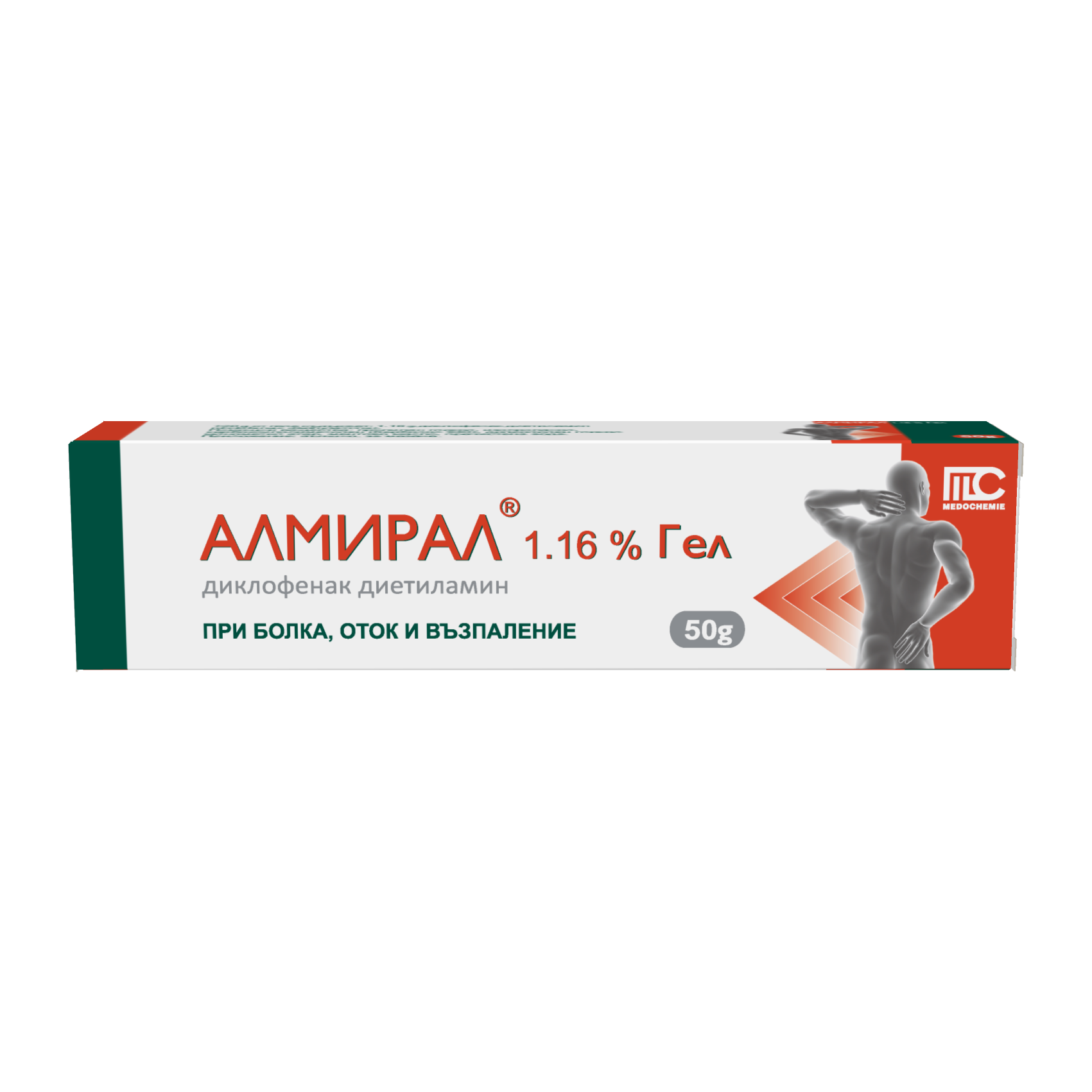
ALMIRAL 50mg x 20 tabl
лекарствена информация
It is not sold online
Add to Favourites
ALMIRAL 50mg x 20 tabl
SUMMARY OF PRODUCT CHARACTERISTICS
1. NAME OF THE MEDICINAL PRODUCT
Almiral Forte 2.32% gel
Almiral Forte 2.32% gel
2. QUALITATIVE AND QUANTITATIVE COMPOSITION
Almiral Forte 2.32% gel contains 23.2 mg/g diclofenac diethylamine, which corresponds to 20 mg/g diclofenac sodium.
Excipients with known effect: propylene glycol (50 mg/g gel); butylhydroxytoluene (0.2 mg/g gel).
For the full list of excipients, see section 6.1.
3. PHARMACEUTICAL FORM
Gel
White to off-white, opalescent, smooth, homogeneous emulgel with a characteristic lavender aroma.
pH: 7.1 – 7.7.
4. CLINICAL DATA
4.1 Therapeutic indications
Adults and adolescents aged 14 years and over
For the relief of mild to moderate pain associated with localized muscle or joint injuries.
Adults (18 years and over)
For the relief of pain in case of localized mild to moderate forms of degenerative rheumatism, e.g. osteoarthritis (of the fingers, knees).
4.2 Dosage and administration
Dosage
Adults and adolescents aged 14 years and over
Almiral Forte 2.32% is applied twice a day – morning and evening.
The amount needed depends on the size of the affected area: 2 g to 4 g of diclofenac gel (an amount the size of a cherry to a walnut) is sufficient to treat an area of about 400-800 cm2.
The maximum daily dose is 8 g of gel and should not be exceeded.
Almiral Forte
Duration of treatment
The duration of treatment depends on the indications and clinical response.
- For muscle and joint injuries (adults and adolescents aged 14 and over), it is not recommended to use the gel for more than 14 days, unless recommended by a doctor.
- For osteoarthritis of the knee or fingers (only adults aged 18 years and over), the duration of treatment is up to 21 days, unless otherwise recommended by a doctor.
The effect of diclofenac gel builds gradually during the first week of treatment.
Patients should consult their doctor if the condition does not improve or worsens within 7 days of starting treatment.
Children and adolescents aged
There are insufficient data on efficacy and safety in children and adolescents below 14 years of age (see also section 4.3 Contraindications).
In adolescents aged 14 years and over, if this product is needed for more than 7 days for pain relief or if symptoms worsen, the patient/parents of the adolescent are advised to consult a doctor.
Elderly patients (over 65 years)
The usual adult dosage is used.
Method of administration
For application to the skin.
The gel is applied to the affected parts of the body in a thin layer and gently rubbed into the skin. Hands should then be wiped with a paper towel and then washed, unless the hands are the area to be treated.
If too much gel is accidentally applied, the excess gel should be wiped off with a paper towel.
The paper towel should be disposed of with household waste to prevent unused product from entering the aquatic environment.
Before applying a bandage, the gel should be allowed to dry on the skin for a few minutes.
4.3 Contraindications
Hypersensitivity to the active substance or to any of the excipients listed in section 6.1.
Patients with a history of asthma, angioedema, urticaria or acute rhinitis that are provoked by acetylsalicylic acid or other non-steroidal anti-inflammatory drugs (NSAIDs).
During the third trimester of pregnancy.
Use in children and adolescents under 14 years of age is contraindicated.
4.4 Special warnings and precautions for use
The possibility of systemic adverse reactions (such as those associated with systemic forms of diclofenac) should be considered when using diclofenac gel at higher doses and for longer than recommended periods (see “Dosage and method of administration”).
Patients suffering from asthma, hay fever, swelling of the nasal mucosa (so-called nasal polyps) or chronic obstructive pulmonary disease and chronic respiratory infections (especially associated with hay fever-like symptoms) are more at risk of asthma attacks (so-called intolerance to analgesics / analgesic asthma), local swelling of the skin or mucous membranes (so-called Quincke's edema) or urticaria compared to other patients when treated with diclofenac gel.
To reduce the very rare risk of photosensitivity reactions, patients should avoid sun exposure, including tanning beds, when using this product. If skin reactions occur, use of this product should be discontinued.
Preventive measures should be taken so that children do not come into contact with the skin areas to which the gel has been applied.
Diclofenac gel should only be applied to healthy and intact skin, avoiding wounds or injuries. This medicinal product should not come into contact with the eyes or mucous membranes and should not be swallowed.
Treatment with diclofenac gel should be discontinued if a skin rash develops after its application.
Diclofenac gel can be used with non-occlusive dressings, but its application with airtight occlusive dressings is not recommended.
Patients should be instructed not to smoke or go near an open flame - risk of severe burns. Fabrics (clothing, bedding, dressings, etc.) that have been in contact with this product burn more easily and pose a serious fire hazard. Washing clothing and bedding may reduce the build-up of the product but will not completely remove it.
Almiral Forte 2.32% gel contains:
Propylene glycol, which may cause skin irritation.
Butylated hydroxytoluene, which may cause local skin reactions (e.g. contact dermatitis) or irritation of the eyes and mucous membranes.
4.5 Interaction with other medicinal products and other forms of interaction
Given the low systemic absorption of diclofenac when the gel is applied topically, similar interactions with other medicinal products are unlikely.
4.6 Fertility, pregnancy and lactation
Pregnancy
The systemic concentration of diclofenac is lower after topical administration compared to that of oral forms.
There are no clinical data on the use of diclofenac gel during pregnancy. Even if the systemic exposure is lower compared to oral administration, it is not known whether the systemic exposure of diclofenac gel achieved after topical application could be harmful to the embryo/foetus.
With reference to the experience of treatment with NSAIDs for systemic use, the following is recommended:
Inhibition of prostaglandin synthesis may adversely affect pregnancy and/or embryo/foetal development.
Data from epidemiological studies have shown an increased risk of miscarriage, as well as of cardiac malformations and gastroschisis after the use of prostaglandin synthesis inhibitors in the first months of pregnancy. The absolute risk of cardiovascular malformations was increased from less than 1% to approximately 1.5%.
The risk is assumed to increase with increasing dose and duration of treatment. In animals, the administration of prostaglandin synthesis inhibitors has been shown to result in increased pre- and post-implantation loss and embryo-foetal death. In addition, an increased number of cases of various malformations, including cardiovascular, have been reported in animals receiving prostaglandin synthesis inhibitors during organogenesis.
During the first and second trimester of pregnancy, Almiral Forte should not be used unless clearly necessary. If used, the dose should be kept as low as possible and the duration of treatment as short as possible.
During the third trimester of pregnancy, all prostaglandin synthesis inhibitors may expose the fetus to:
- cardiopulmonary toxicity (with premature closure of the ductus arteriosus and pulmonary hypertension);
- renal dysfunction, which may progress to renal failure with oligohydramnios.
at the end of pregnancy, the mother and newborn:
- possible prolongation of bleeding time – anti-aggregating effect, which can occur even in very small doses;
- suppression of uterine contractions, leading to delayed or prolonged labor.
Therefore, diclofenac is contraindicated during the last trimester of pregnancy (see section 4.3).
Breastfeeding
Like other NSAIDs, diclofenac passes into breast milk in small amounts. However, diclofenac gel should not be used during breast-feeding to avoid side effects in the breastfed infant. In the absence of controlled studies in breast-feeding women, this medicine should only be used during breast-feeding on the advice of a healthcare professional. For this reason, diclofenac gel should not be applied to the breasts of nursing mothers or elsewhere on large areas of skin for prolonged periods (see section 4.4).
Fertility
If diclofenac is used by a woman attempting to conceive, or during the first and second trimesters of pregnancy, the dose should be as low as possible and the duration of treatment should be as short as possible.
4.7 Effects on ability to drive and use machines
Since the systemic absorption of diclofenac after topical application of diclofenac gel is very low, an effect on the ability to drive or use machines is unlikely.
4.8 Adverse drug reactions
Side effects include mild and transient skin reactions at the application site. Very rarely, allergic reactions may occur.
The systemic absorption of topically applied diclofenac is very low and the resulting plasma levels of diclofenac are also very low compared to plasma levels after oral administration of diclofenac. Therefore, the likelihood of systemic adverse reactions (such as gastrointestinal, hepatic or renal disorders, bronchospasm) is very low after topical administration compared to the incidence of adverse reactions associated with oral administration of diclofenac. However, if diclofenac is used on a large surface area of the skin and for a prolonged period of time, systemic adverse reactions may occur.
Adverse reactions are listed in the table below by system organ class and frequency. The following convention has been used to classify adverse reactions: very common (≥1/10), common (≥1/100 to <1/10), uncommon (≥1/1,000 to <1/100), rare (≥1/10,000 to <1/1,000), very rare (<1/10,000), not known (frequency cannot be estimated from the available data).
Infections and infestations
Very rare: pustular rash.
Immune system disorders
Very rare: angioedema, hypersensitivity reactions (including urticaria).
Respiratory, thoracic and mediastinal disorders
Very rare: asthma.
Skin and subcutaneous tissue disorders
Common: rash, eczema, erythema, pruritus, dermatitis (incl. contact dermatitis)
Rare: bullous dermatitis.
Very rare: photosensitivity.
Reporting suspected adverse reactions
Reporting of suspected adverse reactions after authorisation of a medicinal product is important. This allows the benefit-risk balance of the medicinal product to be monitored. Healthcare professionals are asked to report any suspected adverse reactions via the national reporting system:
Executive Agency for Medicines
8 Damyan Gruev Street
1303 Sofia
Tel.: +359 2 890 34 17
website: www.bda.bg
4.9 Overdose
Due to the low systemic absorption of topically applied diclofenac, overdose is unlikely. However, if diclofenac gel is swallowed, adverse reactions similar to those observed with an overdose of diclofenac tablets can be expected.
In case of accidental ingestion leading to significant systemic adverse reactions, the general therapeutic measures normally taken in poisoning with non-steroidal anti-inflammatory drugs should be used. Gastric lavage and administration of activated charcoal should be considered, especially soon after ingestion.
5. PHARMACOLOGICAL PROPERTIES
5.1 Pharmacodynamic properties
Pharmacotherapeutic group: Topical products for joint and muscle pain. Nonsteroidal anti-inflammatory drugs for topical use, ATC code: M02AA15.
Mechanism of action and pharmacodynamic effects
Diclofenac is a nonsteroidal anti-inflammatory drug (NSAID) with analgesic, anti-inflammatory and antipyretic properties. Diclofenac exerts its therapeutic effect primarily by inhibiting prostaglandin synthesis via cyclooxygenase 2 (COX-2).
Applied topically, it has analgesic and anti-inflammatory properties. In inflammation and pain of traumatic and rheumatic origin, diclofenac relieves pain and reduces swelling.
In a study of ankle sprains (VOPO-P-307), diclofenac gel was found to be effective and rapid in relieving pain: 2 days after the start of treatment, patients who used diclofenac gel had a 32 mm reduction in pain on movement (POM), while the results measured in the placebo group showed a reduction of only 18 mm (p<0.0001). 4 days after the start of treatment, POM, the primary endpoint, decreased by 49 mm on a 100 mm visual analogue scale (VAS) in patients using diclofenac gel, compared with a 25 mm reduction observed in the placebo group. Diclofenac gel was statistically significantly superior in efficacy compared to placebo (p<0.0001).
Diclofenac gel was also effective in treating inflammation. Seven days after the start of treatment, the mean difference in swelling between the injured and contralateral ankles was 0.3 cm for the diclofenac gel group and 0.9 cm for the placebo group (p<0.0001).
Further evidence of the efficacy of diclofenac gel is demonstrated by the median time to 50% reduction in pain on movement (POM), which was 4 days in the diclofenac gel group compared to 8 days in the placebo group (p<0.0001). Therefore, treatment with diclofenac gel accelerated healing by up to 4 days or more.
In a post-hoc analysis, all participants with grade I or II ankle sprains were categorized as above or below a baseline pain on movement (POM) of 80 mm on a visual analogue scale (VAS), and efficacy was examined in each subgroup. Four days after the start of treatment, diclofenac gel was significantly superior to placebo in reducing pain on movement (POM) in both patients with baseline pain ≥80 mm (diclofenac gel 56.4 mm; placebo 27.2 mm; p<0.0001) and patients with baseline pain <80 mm (diclofenac gel 44 mm; placebo 25 mm; p<0.0001), as the primary efficacy endpoint.
Diclofenac gel relieves joint pain caused by exacerbation of osteoarthritis of the knee or fingers. In this indication, the effect of diclofenac gel builds up gradually during the first week of treatment. The efficacy of long-term treatment has not been proven for a period longer than 3 weeks.
5.2 Pharmacokinetic properties
Absorption
The amount of diclofenac absorbed through the skin is proportional to the size of the treated area and depends on the total dose applied and the degree of hydration of the skin. After topical application to approximately 400 cm2 of skin, the degree of systemic exposure, determined by the plasma concentration of diclofenac (2 applications daily), is equivalent to that of diclofenac diethylamine gel 11.6 mg/g (4 applications daily). The relative bioavailability of diclofenac (AUC) for diclofenac gel compared to diclofenac tablets is 4.5% on day 7 (for an equivalent dose of diclofenac sodium). Absorption is not affected by the application of a moisture- and vapor-permeable dressing.
Distribution
Diclofenac concentrations were measured in plasma, synovial tissue and synovial fluid after topical application of diclofenac gel to hand and knee joints.
Maximum plasma concentrations of diclofenac were about 100 times lower than those after oral administration of the same amount of diclofenac. 99.7% of diclofenac is bound to serum proteins, mainly to albumin (99.4%).
Diclofenac accumulates in the skin, which acts as a depot from which a sustained release of diclofenac into the subcutaneous tissues occurs. From there, diclofenac is preferentially delivered and retained in deeply located inflamed tissues (such as joints) rather than in the bloodstream. Diclofenac can be found in concentrations 20 times higher than in plasma.
Biotransformation
The biotransformation of diclofenac involves steps of single or multiple hydroxylation followed by glucuronidation and partial glucuronidation of the intact molecule, leading to various phenolic metabolites, most of which are converted to glucuronide conjugates. Two of the phenolic metabolites are biologically active, but much less so than diclofenac.
Elimination
The total systemic clearance of diclofenac from plasma is 263 ± 56 ml/min. The terminal plasma half-life is 1-2 hours. Four of the metabolites, including the two active ones, also have short plasma half-lives - from 1 to 3 hours. One of the metabolites, 3'-hydroxy-4'-methoxy-diclofenac, has a longer plasma half-life, but it is practically inactive. Diclofenac and its metabolites are excreted mainly in the urine.
Special populations
Kidney and liver damage
Accumulation of diclofenac and its metabolites is not expected in patients suffering from renal disease.
In patients with chronic hepatitis or non-decompensated cirrhosis, the kinetics and metabolism of diclofenac are the same as in patients without liver disease.
5.3 Preclinical safety data
Preclinical data on diclofenac, based on conventional safety pharmacology studies, repeated dose toxicity studies, genotoxicity, mutagenicity and carcinogenicity, reveal no special hazard for humans at the therapeutic dose used. No teratogenic effects were observed in mice, rats and rabbits. Toxic systemic doses in rats were associated with dystocia, prolonged gestation, reduced foetal weight and growth and reduced foetal survival. A known effect of inhibition of prostaglandin synthesis is closure of the ductus arteriosus.
Diclofenac gel causes mild skin irritation in rabbits (redness and dry skin) and shows a low potential for skin sensitization in guinea pigs.
Environmental Risk Assessment (ERA)
Environmental risk assessment studies have shown that diclofenac may pose a risk to surface water (risk to fish), groundwater and secondary poisoning (see section 6.6).
6. PHARMACEUTICAL PARTICULARS
6.1 List of excipients
Propylene glycol (E1520)
Isopropyl alcohol
Carbomer (C980)
Diethylamine
Oleyl alcohol
Liquid paraffin (E905a)
Cocoilprilokaprat
Macrogolcetostearyl ether
Butylhydroxytoluene (E321)
Purified water
Lavender fragrance 57 (contains benzyl alcohol, citral, hydroxycitronellal, limonene, methyl eugenol)
6.2 Incompatibilities
Not applicable.
6.3 Shelf life
24 months
6.4 Special storage conditions
This medicinal product does not require any special storage conditions.
6.5 Nature and contents of container
Box with a soft aluminum tube, laminated on the inside with epoxy phenolic varnish, sealed with an aluminum membrane and fitted with a white polyethylene screw cap. The cap has a suitably shaped spike for piercing the membrane on first use.
Each tube is filled with 100 g of the medicinal product and is packed in a cardboard box together with a patient leaflet.
Box with an aluminium laminated tube (polypropylene/aluminium/polypropylene), sealed with an aluminium membrane and fitted with a white polyethylene screw cap.
Each tube is filled with 50 g, 100 g or 150 g of the medicinal product and is packed in a cardboard box together with a patient leaflet.
Not all types of packaging can be placed on the market.
6.6 Special precautions for disposal
This medicinal product may pose a risk to the environment (see section 5.3).
Any unused medicinal product or waste material should be disposed of in accordance with local requirements.
7. MARKETING AUTHORISATION HOLDER
Medochemie Ltd., 1-10 Konstantinoupoleos str., 3011 Limassol, Cyprus
8. MARKETING AUTHORISATION NUMBER(S)
Reg. No.: 20250186
9. DATE OF FIRST AUTHORISATION/RENEWAL OF THE AUTHORISATION
Date of first authorisation: 30 May 2025
10. DATE OF TEXT UPDATE
11/2025
Express Delivery (within 2 hours)
- Valid only for the city of Sofia
- Valid only for orders over €25.56 | 50.00 BGN
- Valid only for cash on delivery (cash or card payment upon receipt)
Delivery to a Pharmacy
- Completed within up to 2 business days
- Valid for Sofia, Bozhurishte, and Mramor
- Free delivery
- Valid only for online payment
Courier Delivery to an Address
- Completed within up to 3 business days
- €2.30 | 4.50 BGN for orders under €25.56 | 50.00 BGN
- Free for orders over €25.56 | 50.00 BGN
Delivery to a Speedy Office
- Completed within up to 3 business days
- €2.30 | 4.50 BGN for orders under €25.56 | 50.00 BGN
- Free for orders over €25.56 | 50.00 BGN
BOX NOW
- Completed within up to 3 business days
- €1.53 | 2.99 BGN for orders under €25.56 | 50.00 BGN
- Free delivery for orders over €25.56 | 50.00 BGN
* Delivery times may change during large-scale campaigns and busy periods (Black Friday, public holidays, etc.).
* When ordering to a Speedy office, the customer has 5 business days from the delivery date to collect their order. After this period, the order is canceled and returned to the warehouse at subra.bg.

Express delivery for Sofia city Learn more

Free shippingover 50.00 lv / 25.56 €

Click and collect Learn more

Check the shipment Learn more
Book and collect from pharmacy
Availability in store
ALMIRAL 50mg x 20 tabl
Please add your email, to receive notification when the product is in stock
More from same category
Prescription drugs

It is not sold online
EVERIO AIRMASTER Inhalation powder, pre-dispensed 50mcg/500mcg/dose 60 doses