

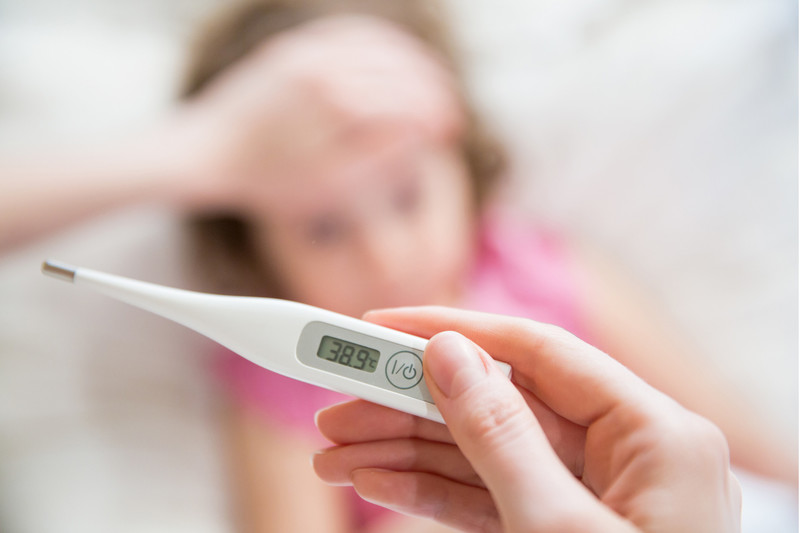
The first rule is not to panic over the thermometer's readings! The second is not immediately to reach for medication! If you successfully manage both recommendations, the fever will subside on its own.
It may sound like a joke, but the phrase "emergency measures for fever" does not exist as a term in medical jargon. The best thing you can do for yourself and others with a high fever is to do nothing to lower it. Trust your body! It will signal when you need to step in for help.
Let’s start with the fact that a body temperature of 37 or 38 degrees Celsius does not fall under the category of "high fever." The difference between elevated and genuinely high temperatures is at least 2 degrees, and the point at which it becomes dangerous is only when the thermometer approaches or exceeds 40 degrees Celsius. At that point, waiting is unnecessary, and action must be taken.
FEVER CONTROL
Do not try to rapidly reduce the fever! We understand how alarming the number 40 on the thermometer can be, especially when it concerns children, but controlling the temperature reduction is extremely important.
In their fear or desire to quickly ease suffering, many people believe that body temperature should be normalized as quickly as possible and kept at the lower end for as long as possible. However, this puts additional stress on an already exhausted body and reduces the strength of the immune response. The body receives a "false signal" that the infection (illness) has ended, which opens the door for still-active viruses and bacteria. As a result, the rapidly lowered fever returns with even higher numbers once the medication's effects wear off. But now, you have lost the chance to fight the illness.
Exercises for rapidly lowering fever are entirely inappropriate for children and infants due to the risks involved. The rapid constriction of blood vessels is a shock to the young body and can trigger so-called febrile seizures. The reason is the immature child's brain, which cannot manage such complex and rapid changes. The adult brain can control both the rise and fall of body temperature, but in the early years after birth, variations in thermometer readings are an entirely unfamiliar biological process.
THE FORMULA: 1 DEGREE PER HOUR
Experts recommend lowering a high fever by no more than 1 degree Celsius per hour. This is a much more challenging task than simply taking a pill. It is a major mistake to take antipyretics, anti-inflammatory drugs, or antibiotics unless specifically prescribed by a doctor.
To reduce high fever without deactivating the body's defenses, it is enough to cool the body.
Try to reduce clothing or stay in a short-sleeved shirt in the room for a while. The exercise is not easy, especially with chills, but if you manage to do it, you can avoid medication. Wet compresses. A well-known "grandma's remedy," but still unmatched in the fight against high temperatures. Wet a few towels with cold water and place them under the armpits and in the groin folds. Another option is to dampen a sheet or large towel and wrap the patient in it, covering them with a blanket. Although rubbing alcohol or vinegar is deeply rooted in traditional medicine, it won’t play a significant role here. Cool bath or shower. This is particularly suitable for babies and young children. The water temperature should be close to or equal to body temperature, around 37 degrees Celsius. Once the child gets used to this temperature, you can gradually lower it to 35-36 degrees. Never take a cold shower or pour cold water over the child to avoid causing a temperature shock. Some grandmothers recommend large amounts of garlic and ginger to sweat out the heat, but if you have a better idea, use it. If you manage to sweat profusely, the moisture on the skin will act like a compressor cool shower, gradually lowering the high fever.
If the temperature does not drop despite the measures taken, be sure to consult a specialist.
THE FEARFUL FEBRILE SEIZURES
As mentioned earlier, they result from the immature functions of the young brain and are not related to pathological changes or diseases. In most cases, they are harmless and occur as isolated incidents.
Febrile seizures occur in 2% to 5% of children aged 6 months to 5 years. They are more common in boys than girls and occur because body temperature rises (or falls) too quickly, not because it is prolonged.
A simple febrile seizure is brief, rarely lasting more than 5 minutes, and does not recur within 24 hours. The sight is shocking, as the body shakes or arches, and the arms move uncontrollably. The child loses consciousness for a short time but keeps their eyes open. Breathing slows and becomes noisy and sometimes stops for a few seconds. Vomiting is also possible.
In complicated febrile seizures, the episode lasts longer and recurs within 24 hours. Another feature is that it does not affect the whole body, only part of it.
Regardless of the situation, the parents' correct behavior is crucial.
Unbutton the child's clothes and place them on their side to prevent choking or gagging. You can support the child to prevent injury from nearby objects or falling but without restricting body movements or forcefully stopping the seizure. Do not try to give food, water, or medication during the seizure. The swallowing reflex does not work when the child is unconscious. Measure the duration of the seizure from start to finish. Wait for the seizure to pass and immediately take the child to a doctor.
The specialist will perform an electroencephalogram (EEG) to rule out other nervous system problems, such as meningitis, encephalitis, or epilepsy. It is important to know that proof of a febrile seizure is only a clean EEG. If the examination shows organic damage, the cause of the seizure is a serious illness, not a high fever.