


 Click & collect





Ще се изтрие най-старият артикул от любими и ще се добави новият
In stock
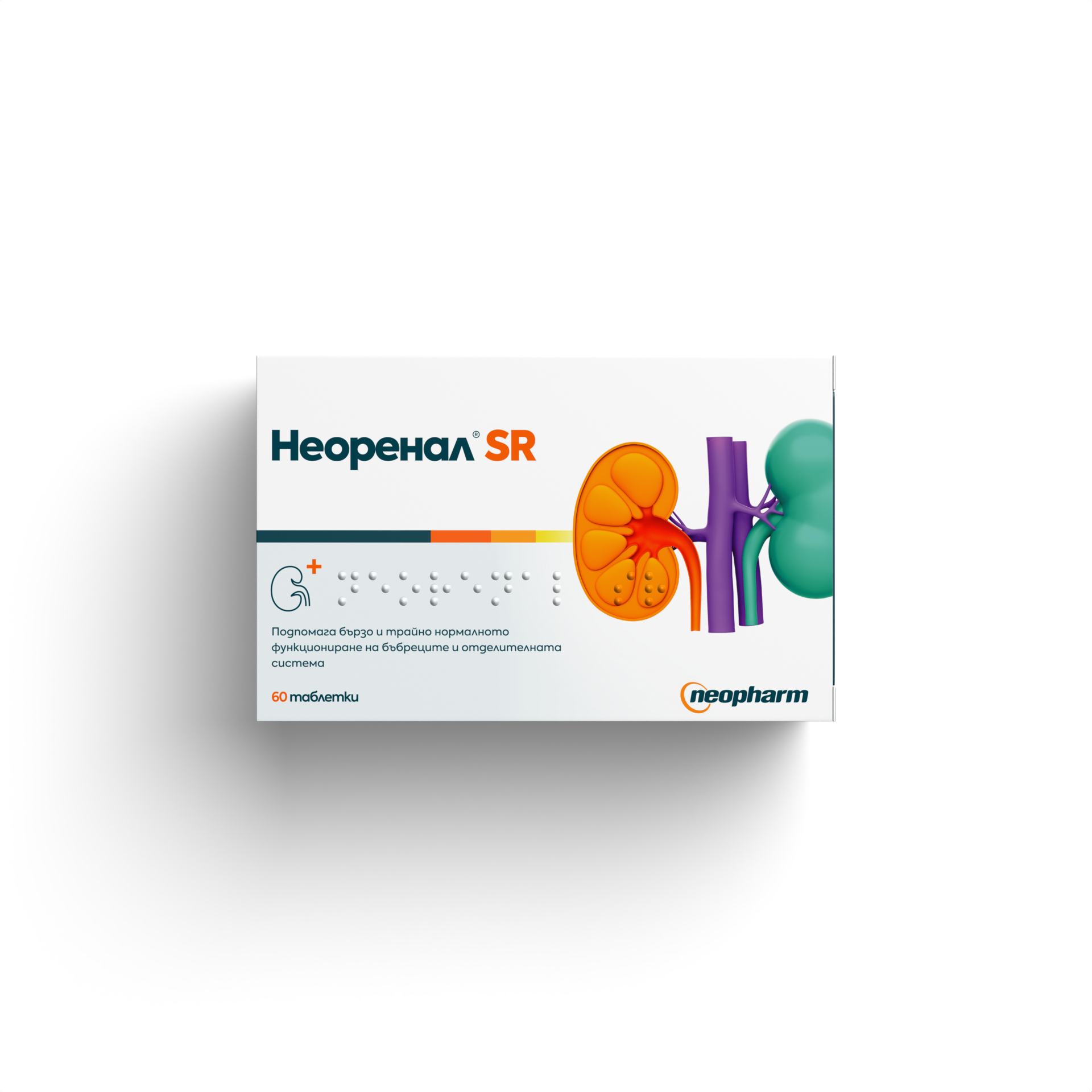
NEOPHARM NEORENAL SR for kidney health 730mg x 60 tabl new
22.19 €
Add to Favourites
NEOPHARM NEORENAL SR for kidney health 730mg x 60 tabl new
Neorenal® SR
Supports the normal functioning of the kidneys and urinary system quickly and permanently
60 tablets
Read this leaflet carefully before you start taking the medicine.
If you have any further questions, ask your doctor.
Contents of the leaflet:
I. What is good to know about kidney infection?
II. What is Neorenal® SR?
III. How does Neorenal® SR work and who is it intended for?
IV. How is Neorenal® SR taken?
V. Who should not take Neorenal® SR?
VI. What are the side effects of Neorenal® SR?
VII. Storage
I. What is good to know about KIDNEY INFECTION?
Kidney infection, or pyelonephritis, is among the most common diseases of these organs. It is an inflammation of the renal parenchyma and pelvis, caused by bacteria that have entered them. In over 70% of cases, kidney infection is due to the bacterium E. coli. Other causes of the disease can be bacteria from the genera Proteus, Klebsiella, Pseudomonas, etc.
Some of the causes of kidney infections become resistant to antibiotic treatment by transforming into L-forms. In this form, the bacteria lose their outer shell, called the cell wall, which most antibiotics work on, and are left with only their inner shell, the cell membrane. It is believed that these are responsible for the chronicity of the infection.
L-forms are not sensitive to antibiotics, but due to the lack of a cell wall, they are strongly affected by the concentration of urine. When urine is diluted, its osmotic pressure allows water to enter the L-form cell. As a result, it swells and at some point can "burst". Therefore, it is especially important in kidney infections to maintain the osmotic pressure of urine at optimal physiological values.
Usually, harmful microorganisms spread in the urinary tract by ascending. They penetrate from the external environment into the urinary canal (urethra), enter the bladder and can reach the ureters and kidneys. Microorganisms can also reach the kidneys through the bloodstream from other parts of the body.
A prerequisite for the development of a kidney infection is a violation of the outflow of urine from the kidneys. Often this violation can be due to the presence of kidney stones, with or without renal crisis. Various anatomical defects in the structure of the urinary tract can also lead to a change in the normal flow of urine. The placement of a urethral catheter is another risk factor that can cause the penetration of microorganisms into the urinary tract and the subsequent development of a kidney infection.
Increased urine concentration is also a risk factor because it provides a favorable environment for L-forms of bacteria. It is no coincidence that pyelonephritis is more common during the summer months, when, with insufficient fluid intake, the body becomes dehydrated due to sweating and excretes a smaller amount and more concentrated urine.
Pyelonephritis is more common in women because of the shorter urethra and its proximity to the vagina and anus, which predisposes to contamination with microorganisms. Pregnancy is also a predisposing factor for the development of kidney infection due to the hormonal changes that occur during this period and the pressure that the fetus puts on the ureters, which makes it difficult to normally remove urine from the body. As men age, kidney infection also becomes a common problem. This is due to the enlargement of the prostate and difficulty urinating, which creates favorable conditions for the development of infection.
Pyelonephritis can be acute and chronic depending on its course and the causes that provoked its occurrence.
The most common symptoms of a kidney infection are: pain on one or both sides of the back, just below the ribs, fever, shaking, chills, nausea, vomiting, urine may be cloudy, have an unusual odor. Urination may be more frequent than normal and be accompanied by discomfort or pain.
II. What is NEORENAL® SR?
Neorenal® SR is a product that quickly and permanently supports the normal functioning of the kidneys and the excretory system. It maintains the normal physiological sterile environment of the renal pelvis and ureters.
Each Neorenal® SR tablet contains:
· Patented standardized dry extract of Birch leaves (Betula pendula) – 500 mg
· Patented combination Vivache®: Extract of Herniaria (Herniaria glabra), Viburnum (Viburnum opulus), American cranberry (Vaccinium macrocarpon) – 130 mg
· Ursolic acid – 50 mg
Other ingredients: fillers - microcrystalline cellulose, magnesium stearate, copovidone, povidone, film with dyes (brilliant blue FCF, iron oxide).
Neorenal® SR is a dietary supplement.
III. How does NEORENAL® SR work and who is it intended for?
Birch leaf extract has been proven to have a number of properties that support the functioning and health of the kidneys and urinary tract. It supports the natural formation of urine and the elimination of metabolic waste products with the act of urination. It maintains the osmotic pressure of urine at optimal physiological values.
Vivache® consists of a specially created combination of extracts of Herniaria (Herniaria glabra), Viburnum (Viburnum opulus) and American cranberry (Vaccinum macrocarpon). The ingredients in the combination mutually enhance and complement their beneficial effects on the kidneys and urinary tract. They support the physiological process of urine formation, the act of urination and help maintain the urinary tract in its natural physiological purity. They maintain the normal tone of the smooth muscles in the urinary system.
Ursolic acid maintains the normal physiological sterile environment of the renal pelvis and ureters, neutralizes free radicals and supports normal kidney function.
Neorenal® SR can be administered concurrently with antibiotic treatment.
IV. How is Neorenal® SR taken?
Unless your doctor has recommended otherwise, take Neorenal® SR 1 tablet 2 times a day.
V. Who should not take Neorenal® SR?
Do not take Neorenal® SR if you have ever had an allergic reaction to any of the ingredients of the product. If signs of an allergic reaction occur, discontinue use of the product.
Do not exceed the recommended daily dose. Do not use as a substitute for a varied diet.
VI. What are the side effects of Neorenal® SR?
So far, there are no known side effects of the product and contraindications for its use. Its tolerance is very good, which allows safe use for a long period of time. Neorenal® SR can be used during pregnancy and lactation, as well as in people with diabetes.
VII. Storage
Store Neorenal® SR in its original packaging at a temperature of up to 25°C, in a dry place, out of direct sunlight and out of reach of small children.
Do not use the product after its expiration date or if the integrity of the packaging is compromised.
Express Delivery (within 2 hours)
- Valid only for the city of Sofia
- Valid only for orders over €25.56 | 50.00 BGN
- Valid only for cash on delivery (cash or card payment upon receipt)
Delivery to a Pharmacy
- Completed within up to 2 business days
- Valid for Sofia, Bozhurishte, and Mramor
- Free delivery
- Valid only for online payment
Courier Delivery to an Address
- Completed within up to 3 business days
- €2.30 | 4.50 BGN for orders under €25.56 | 50.00 BGN
- Free for orders over €25.56 | 50.00 BGN
Delivery to a Speedy Office
- Completed within up to 3 business days
- €2.30 | 4.50 BGN for orders under €25.56 | 50.00 BGN
- Free for orders over €25.56 | 50.00 BGN
BOX NOW
- Completed within up to 3 business days
- €1.53 | 2.99 BGN for orders under €25.56 | 50.00 BGN
- Free delivery for orders over €25.56 | 50.00 BGN
* Delivery times may change during large-scale campaigns and busy periods (Black Friday, public holidays, etc.).
* When ordering to a Speedy office, the customer has 5 business days from the delivery date to collect their order. After this period, the order is canceled and returned to the warehouse at subra.bg.

Express delivery for Sofia city Learn more

Free shippingover 50.00 lv / 25.56 €

Click and collect Learn more

Check the shipment Learn more
Book and collect from pharmacy
Availability in store
NEOPHARM NEORENAL SR for kidney health 730mg x 60 tabl new
Please add your email, to receive notification when the product is in stock